|
Mapleton is a small town located on the Maple river in Monona
County about 20 mile east of Onawa. I remember it as a very happy
place to live in the late thirties, and many of my fondest memories
of childhood are of living there. All of our family says to this day
that Mapleton was a "kids town".
|
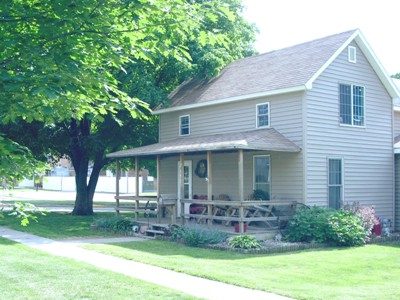
"Godberson House"
311 S. 7th Street
(c. 2009 - schoolground in the background across the street) |
We lived in the bottom part of an old two-story house that was
right across the street from Mapleton school. The house was owned by
an old German emigrant named Godberson (His son now owns Midwest
Industries in Ida Grove which makes Shorelander boat trailers). Old
"Gobberson" (as we called him) was mean and grumpy, had a heavy
guttural German accent, and was an ardent and vocal supporter of
Adolf Hitler.
At home were Mom and Claud, Ward, Darrel, Winnie (for a short
time), and me; and Claud's children, Martin and Virginia Sammons. Carol was married and gone, as were Paul and Edwin Sammons (Ed was
in the CCC camp).
I started Kindergarten in Mapleton. I don't remember any of my
teachers, but I remember a few of the other children:
|
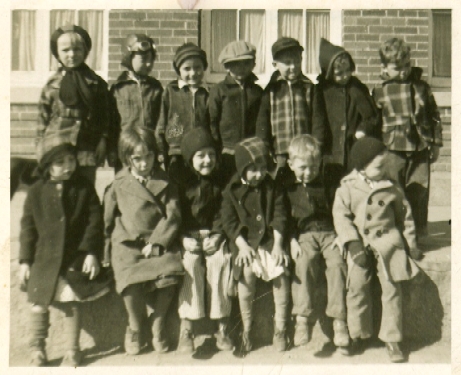
1938 - Kindergarten
Back Row: Leon (3rd from left), Kay Bratt
(2nd from right)
Front Row: Gretchen and Elaine Pauley (front-left),
Roger Moore (2nd from right) |
My girlfriend's name was Kay Bratt. She had a little red and blue
cape with a hood on it, (just like Red Riding Hood's, I thought). She carried a little parasol and wore black patent leather shoes. I
thought she was really neat! In contrast to Kay Bratt was Elain
Pauley and her sister Gretchen. They were very poor, and the other
kids made fun of their old raggy clothes and shoes. I always felt
very sorry for them, and to this day can remember the haunting look
of their eyes and of them crying because others taunted them.
Roger Moore was my best friend. We played together a lot. I was
fascinated with his ability to carve chains from a piece of wood.
Another friend, Richard, lived on a farm and took the school bus
every day. I decided to ride home with him one day because he said
he had tinker toys to play with. His folks weren't very glad to see
me, but fed me supper then drove me back into town just as it was
getting dark. I had them let me off at the park (about two blocks
from home) and walked on home from there. Darrel and Virginia met me
on the way home, and were elated to see me (they thought the gypsies
had taken me). Everyone in town was looking for me. When I got home,
I got bawled out but (to my surprise) didn't get a spanking.
|
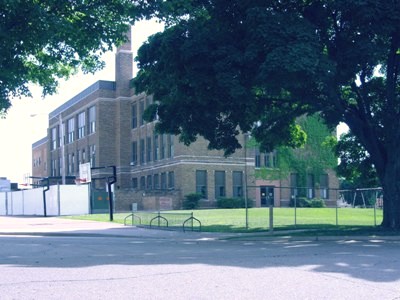
Mapleton Grade School
(c. 2009 - as seen from
"Godberson" house) |
I remember other things about the school, such as when the new
gymnasium was built, and of being the unofficial mascot of the
basketball team (they called me "Gunner"). I used to stand up with
the cheerleaders and knew all of the "yells" (the only one I still
remember is, "Wash 'em out, ring 'em out, hang 'em on the line. We
can beat Onawa any old time!"). I remember all of the pep
rally
bonfires, and how everyone would haul anything that was combustible
including lumber, boxes, furniture, tires, old farm wagons, old
out-houses, etc. to make a huge pile for burning.
Playing marbles in the schoolyard after school was a very popular
pastime. I was pretty good, and won a lot of marbles, though Darrel
was the real expert. "Aggies" were the real prize, and "commies"
(made from fired clay) were usually not acceptable as real marbles. If you had a good "aggie shooter" or a shiny "steelie"
(ball-bearing) you were really lucky.
|
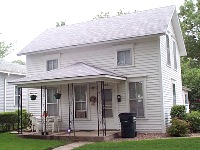
204 S. 5th Street
(c. 2001) |
We moved from the Godberson house to another place a few blocks
away. The house was a small two story frame house with a large porch
on one side.
It seems we only lived there a short time and then
moved about a block down the street a big old two story house with
lots of room that we rented from the county. We lived there until we
left Mapleton. It was a big yellowish house with a cindered driveway
part way up one side of the lot. It had a huge, windowed in back
porch and a big shed out by the alley. We thought we had the finest
house in town when we moved there.
|
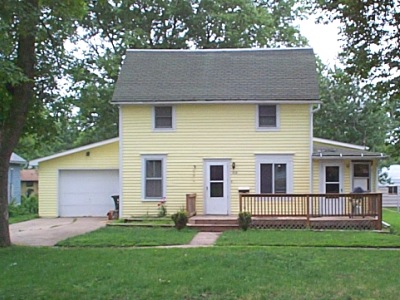
"Yellow
House"
305 S. 5th Street
(c. 2001 - still yellow!) |
There were bedrooms upstairs, and I remember sleeping with Darrel
on a small cot. It was cold up there in the winter since the only
heat came up through a vent in the downstairs ceiling. We didn't
waste any time getting dressed and getting downstairs where a big
grate in the dining room floor directly over the furnace supplied
the heat for the whole house. You could warm up there in a hurry if
the soles of your feet could stand it.
Now and then, Mom would give me a penny, and I would walk over to
the little station on the highway (about two blocks away) and buy a
piece of penny candy. They had a display case full that included
tootsie rolls, all-day suckers, bubble gum, hard candy, taffy
rolls, little candy bars, and "Guess Whats". It took 10 or 15
minutes to decide what to buy (looking was the most fun). I usually
ended up with Guess Whats. Each one contained 2 large candy kisses
and a prize wrapped in colored paper like a little loaf of bread. The prizes were Japanese trinkets such as tin whistles, chain
puzzles, tin soldiers, rings, etc. I don't ever remember being
disappointed in the prize. It was always something neat.
|
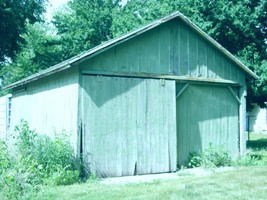
Shed behind Yellow House (c. 2009) |
I remember one time finding an Indian head penny in the attic of
our old shed that had been nailed through with a 16 penny spike to
the rafter. I spent hours prying out the nail and flattening the
penny with a hammer to make it look presentable. I walked down to
the little station, worrying all the way as to whether the lady
would accept the beat up penny. She did (with no fanfare) and I was
both relieved and happy that my efforts were not in vain.
For toys, we made things ourselves to play with. We cut up old
rubber intertubes to make rings for rubber guns, and rubbers for
sling shots. Our lumber supply for making all kinds of things was
provided by discarded orange crates and lath. We carved rubber guns
out of orange crate ends. We made wooden scooters out of orange
crates and lath with an old pair of roller skates flattened out and
nailed to the bottom. We used to guide a barrel hoop around with a T
made from lath. We also used lath T's for swords and daggers. We
made push carts from orange crates and an old pair of buggy wheels. We made necklaces from discarded keys. We made darts from
matchsticks with a pin in one end and paper "feathers" on the other. We made little wind-up tractors out of thread spools, matchsticks,
and a rubber band. We used a big button on a string to make a
"whizzer".
My brother, Darrel, made the best slingshots in town. He would
cut a crotch from an ash tree, bark it, and wire the two arms
together to form a perfect arch. Then he would bake it in Mom's oven
until it was dry, trim it up and notch it out for the rubbers. He
tied the rubbers and the pouch (made from an old shoe tongue) on
with string.
Darrel used to take me "junking". He would tie an old model T
coil magnet on his belt with a string, and I would carry a burlap
"gunny sack". We would go up and down the alleys testing the scrap
metal in everyone's junk pile with the magnet. If it didn't stick,
we threw it in the sack. When we got a sack full, we took it to the
junkyard where the man sorted it out, threw out anything that was
suspect, weighed the rest, and gave us (on a good day) a dime for
our day's effort. We then blew the dime on candy.
Every house had a junk pile back by the alley. All garbage, junk,
tin cans, etc. was thrown in the junk pile and burned. When the pile
of burned out refuse got too big, Dad got hold of the "junkman" to
have it hauled away. His name was Ross Dorothy, and he drove a huge
wagon pulled by a pair of horses named "Nip" and "Tuck". Ross was a
pleasant man who really liked kids. He hauled junk for everyone in town,
so was always busy and was never hard to locate. He loaded the wagon
with a scoop shovel and hauled it south of town a mile or two to the
town dump. Along the way, kids (including us) would jump on the
wagon for a ride and sometimes travel all the way to the dump with
him. While he was unloading, we would rummage around in the junk to
find some castoff article that, by applying some imagination, we
could make something to play with out of. The dump was entirely open
and smoldered from numerous fires. It contained all types of refuse
including junk, garbage, animal carcasses, etc. and for obvious
reasons, didn't smell too good. When Ross was finished, we would
jump back on the wagon and ride back into town.
It seems to me that "Mucky Creek" was located not too far from
the dump. This area was timbered, and had little grassy plateaus
along the creek that were ideal for playing games such as
hide-and-seek, tag, and capture-the-flag. Each plateau was roughly
20 yards wide and surrounded by small ravines or draws. The area had
a unique, mystical aire about it because it was dark and shady, and
because the Indian tribes supposedly once lived there. There were
also stories about great battles being fought there among the
Indians. Whatever the case, we found many artifacts such as arrow
heads and axe heads in the area. It was always fun to go there with
a bunch of other kids and play games or just look for Indian
artifacts.
My Dad (Claud) worked at Bill Haubrich's lumber yard (where he
made $23 a week.) Next to the lumber yard on one side was a coal
yard and on the other was a sale barn in a small park. The whole
area was fronted by a railroad track, and was only a couple of
blocks from downtown. I can remember hanging around the sale barn at
auction time and marveling at the fact that the farmers seemed to
understand the constant, unintelligible barking of the auctioneers.
I can also remember when the gypsies would arrive in town with
their colorful wagons, and set up camp in the small park. All of the
mothers in town would caution their kids to stay away from the
gypsies because they reportedly kidnapped children and hauled them
away with them. The town marshal hung around keeping an eye on
them, and the merchants followed them around in the store. It was
always a relief to everyone when they left town.
|
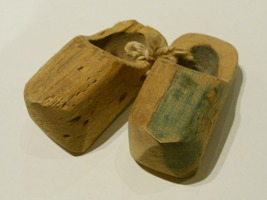
10c Gift for Mom
which Darrell and I bought at the dime store
after a great deal of
shopping and contemplation |
We traded at the "Golden Rule" grocery store on the main street. It was a large two-story building with the grocery store on the main
floor. It was run by a Jewish couple named Abraham (the woman's name
was Bess). No one paid for anything with cash, it seemed. They kept
a little receipt book with the family name on it for each customer. On payday, people came by to pay their bill (if you forgot, they
would offer gentle reminders that you were behind). They were very
good to their customers and every year, the Abrahams had a free "all
you can eat" pancake and sausage dinner in the upstairs hall for
their customers, and everyone looked forward to that event.
The carnival used to come to main street every summer for about a
week. The street was blocked off and all of the rides were set up in
the street. Rides were a dime, and kiddie rides were a nickle.
One year, my father Harry Hindman and his wife Jeanette lived in
Mapleton for a short time. I stopped by his place one day as it was
right across the street from the gas station that had the penny
candy. He lived upstairs in an old house. He was glad to see me and
gave me a DOLLAR ! I decided that I wouldn't feel comfortable having
a whole dollar in my possession, so I asked him to keep it for me and
I would get part of it as I needed it. I left with visions of all of
the Guess Whats and candy that I would be able to buy for all
foreseeable future.
For days, I looked at things in the dime store that a dollar
would buy, but couldn't decide on anything worth spending my
precious dollar on. The next week, the carnival came to town. I
loved to ride the little brightly painted kiddie cars that went
round in a circle on a platform. They had a steering wheel that you
could turn and a little squeeze horn on the side. I decided to get a
quarter of my money from my father to spend on riding the little
cars. I walked 6 or 8 blocks to my father's, got a quarter, went back
to the carnival, and rode the little cars until the quarter was
gone. I repeated this three more times until the last nickle was
spent. The next morning, it hit me that I was once again a pauper,
my precious dollar gone, and all of my dreams about unlimited candy,
etc. gone with it. I was depressed.
I remember some of the kids that lived in our neighborhood that
we played with. Next door was Buddy Kuncle. Buddy was a little older
than I, and didn't like to play with me much because he thought I
was too little. I remember that he got very sick and finally died
from something called leukemia, and I was very sad.
Janet Newbom lived across the street. She was a cute, pleasant
little girl, and I liked her. I used to swing her on her tire swing. She had Polio, and walked with braces and crutches. Johnny Martin
lived across the street and on the corner. He was older than I, and
was my hero. He could climb anything like a monkey, and showed me
how to climb trees, swing on ropes (like Tarzan), and jump off of
sheds without hurting myself. J.P.Cook was really Darrel's friend,
and was about his age.
|
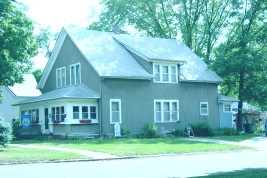
Barber's House (c. 2009)
The barbershop
was the little porch on the back |
He lived by the park in a nice home. He and
Darrel used to include me in their games and adventures, so I
thought he was neat. He accidentally hit me in the eye one time with
a dirt clod and felt terrible about it (years later, Darrel
confessed that it was really he that hit me and that J.P. took the
blame for it). Down the alley from our house about a block was the
barber shop. It was on the back of the barber's house, and had two
chairs. It cost a quarter for a haircut.
Winter was an anticipated event and I remember some of the fun we
used to have. The sledding hill was called "Slimer's Hill" and was
at the edge of town not far from the school. We used to sled by the
hour on that hill, and I don't remember the cold bothering us. Another thing I remember doing with our sleds is hooking a ride on
the back of Ross Dorothy's wagon and being pulled all over town.
Christmas is not well remembered, except that we each got a toy
and had a big family dinner. The Legion Hall downtown gave each
child a bag of Christmas candy, nuts, and oranges each year. We
would go downtown to their building and stand in line for our
goodies.
About two blocks from our house was a big park. It was just
grass, bushes, and trees but afforded a great place to play games
with the other kids in the neighborhood.
|
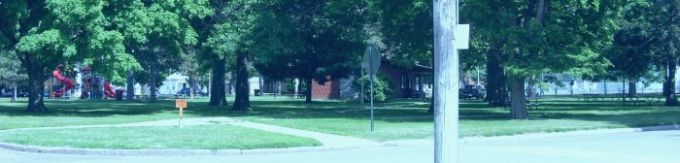
View of Mapleton Park (c. 2009) |
On a summer evening,
everyone used to gather there and we would play hide-and-seek,
kick-the-can, or capture the flag until after dark. In the winter,
we built snow forts and had snowball fights.
|
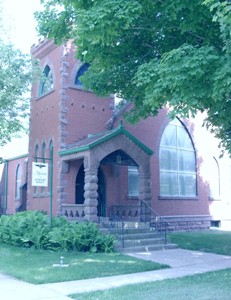
Methodist Church (c. 2009) |
Just across the street from the park was the Methodist church
that I belonged to. I don't remember my parents or brothers and
sisters ever going there with me. I remember being in Sunday school
and the children's choir. I still remember many of the songs I
learned there.
Every week, Mom would give us each a dime allowance to go to the
movies. The Saturday matinee cost a nickle and a big box of popcorn
was another nickle. I used to sit in the front row and watch the
movie more than once before I left. One time, I fell asleep curled
up in the seat, and didn't come home for supper. Everyone was out
looking for me all evening, and thought I had been kidnapped. They
finally found me in the theater, and I was still asleep in the front
row.
As I said earlier, Mapleton was a great place to live for a kid
in the 1930's. I remember other bits of trivia such as the hobo
jungle down by the rail yards, a big flood of the Maple Valley one
year, an airplane flying over town and dropping fake money leaflets,
the swimming pool, and the noon siren sounding every day, the day
Dad came home with a "new car" (a '36 Plymouth to replace our Model
A). I have very happy memories of Mapleton, and remember the
disappointment we all felt when the folks announced that we were
moving to Onawa in 1941. I was in the third grade...
|


